
Is my driver's license photo enough to create a fake ID, from my phone?
How a single driver's license photo can seed a fake ID from photo and deepfake fraud, and why document-plus-selfie checks no longer stop synthetic identity attacks.
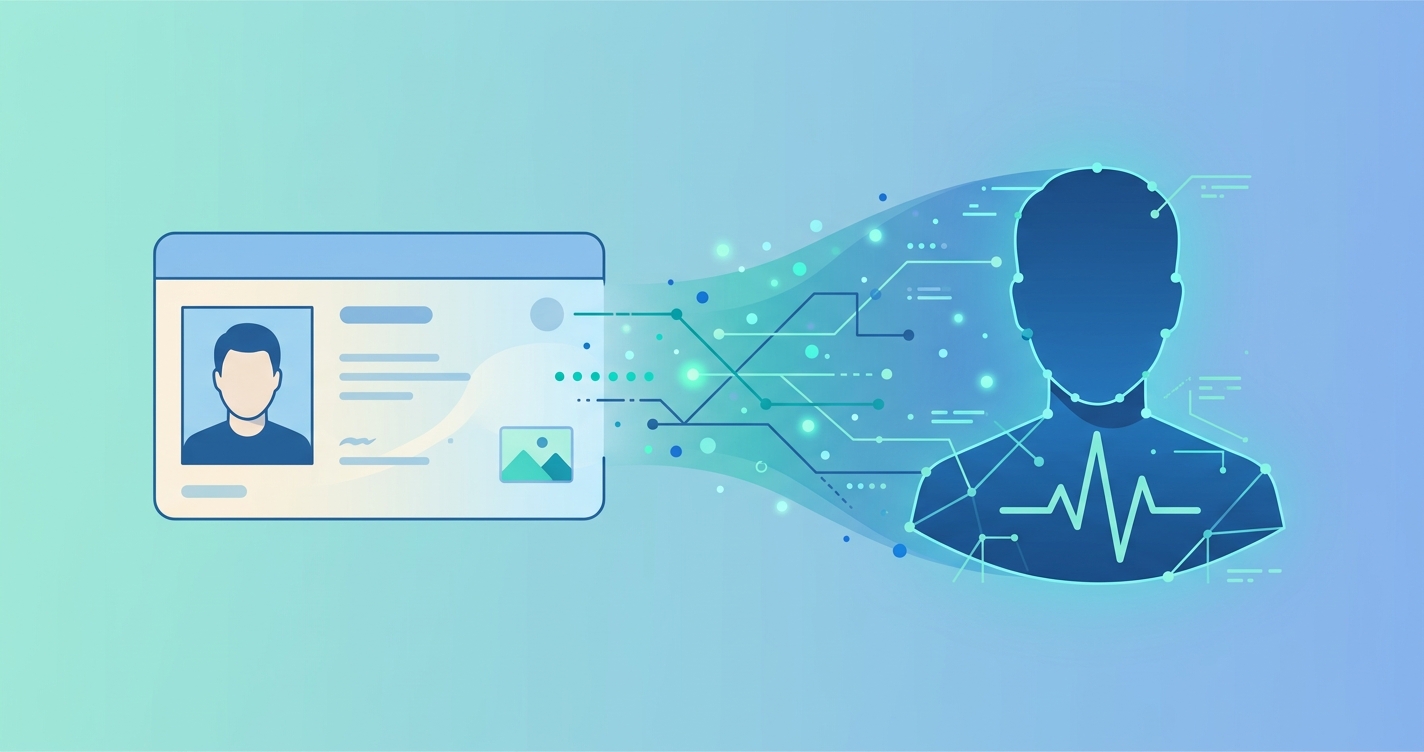
The uncomfortable answer is yes, and the barrier is lower than most people assume. A driver's license carries a high-resolution, well-lit, front-facing portrait shot under controlled conditions, which is close to the ideal input for a generative model. Building a fake ID from photo material that lives on your phone, in a cloud backup, or in a breached government database no longer requires a forger with specialist equipment. It requires a face image, a consumer GPU or a cloud subscription, and an off-the-shelf model. For identity verification vendors and KYC teams, the threat is not that a single image leaks. It is that a static portrait is enough raw material to manufacture both a forged document and a convincing synthetic face that can be replayed into a selfie or video check.
"Deepfake attacks have grown by more than 2,000% over the past three years and now account for roughly one in fifteen identity-fraud attempts, with a deepfake attempt recorded about every five minutes." - Entrust, 2025 Identity Fraud Report
Why a fake ID from photo is now a realistic threat
A driver's license photo is structured data dressed up as a casual snapshot. It is frontal, evenly lit, neutral in expression, and high in resolution, which removes most of the variables that used to make face synthesis difficult. From that single frame, an attacker can do two distinct things. First, they can clone the portrait onto a fabricated document template, producing a forged or altered ID that passes a quick visual review. Second, and more dangerous for remote onboarding, they can animate the face into a moving deepfake that blinks, turns, and smiles on demand.
This second capability is what breaks the assumptions behind most identity flows. Verification has historically rested on two pillars: does the document look genuine, and does the live selfie match the document. A high-quality fake ID from photo input attacks both pillars at once. The document is synthetic, and the selfie is a deepfake derived from the same source image. The two artifacts agree with each other because they came from the same seed, so a naive match check actually reinforces the fraud rather than catching it.
The volume numbers explain why this has moved from theory to operational risk. According to figures compiled across the industry in 2025, files created using deepfake technology grew from roughly 500,000 in 2023 to around 8 million in 2025. LexisNexis reported that synthetic identity fraud rose roughly eightfold globally in 2025 compared with 2024, reaching about 11% of all reported fraud. Entrust's 2025 report logged a 244% year-over-year rise in digital document forgeries. The raw material for these attacks is exactly the kind of clean portrait found on a license.
How the attack surface compares
Not every image carries the same risk, and not every verification method responds the same way. The table below maps common face-image sources against how usable they are for fabricating a fake ID from photo and a matching deepfake selfie.
| Image source | Quality for face synthesis | Document forgery risk | Deepfake selfie risk | What stops it |
|---|---|---|---|---|
| Driver's license / passport portrait | Very high (frontal, lit, high-res) | Very high | Very high | Liveness that reads physiological signals |
| KYC selfie from prior onboarding | High | Medium | Very high | Injection and replay detection |
| Social media profile photo | Medium to high | Medium | High | Passive liveness + provenance checks |
| Video call screen grab | Medium | Low | High | Frame-consistency + blood-flow analysis |
| Low-res tagged group photo | Low | Low | Medium | Standard match thresholds |
The pattern is clear. The cleaner and more frontal the source image, the more dangerous it is, and the official identity portrait sits at the top of that list. The defenses that survive this shift are the ones that stop relying on appearance and start verifying something a static image fundamentally cannot reproduce.
Key takeaways for fraud teams:
- A single official portrait can seed both halves of a document-plus-selfie check.
- Match-based logic can be turned into a liability when both artifacts share one source.
- Image quality, not image quantity, is the strongest predictor of synthesis risk.
- Detection has to target signals that exist only in live human tissue, not pixels.
Industry applications for detection
Banks and fintech onboarding
Remote account opening is the most exposed surface because it is fully unattended and high value. Industry surveys in 2025 found that 49% of businesses had encountered fraud schemes using audio or video deepfakes, with average losses approaching $450,000 per incident. U.S. unsecured credit losses tied to synthetic identities reached approximately $2.94 billion in 2025, up from $1.8 billion in 2020. A face image lifted from a license or a prior application is the seed for the synthetic applicant that drives those losses.
Kyc and identity verification vendors
Vendors sit between the fraudster and their client institutions, which makes their detection layer the deciding factor. When a fake ID from photo and a deepfake selfie are generated from the same portrait, document authentication and face matching can both return green. The defensible position is to add a signal that the source image simply does not contain, rather than tightening match thresholds that punish legitimate users.
Government and high-assurance programs
Public-sector digital identity programs hold exactly the portrait databases that make this attack efficient at scale. A breach or insider leak of license imagery hands attackers a curated library of high-quality faces. Detection here has to assume the reference image is already compromised and verify the live human in front of the camera instead.
Current research and evidence
The research consensus through 2025 is that appearance-based detection is losing the arms race. As generative models improve, frame-level artifacts that older detectors relied on, such as irregular blinking, warped earrings, or inconsistent lighting, are disappearing. This pushes the field toward physiological and behavioral signals that synthetic media struggles to fabricate.
Remote photoplethysmography, or rPPG, is central to this shift. The technique measures tiny color changes in facial skin caused by blood flowing through capillaries with each heartbeat. The foundational work by Verkruysse, Svaasand, and Nelson in 2008 showed that a standard camera can recover a pulse signal from ambient-light video of the face. Poh, McDuff, and Picard at MIT extended this into reliable multi-channel cardiac measurement in 2010 and 2011. The security implication is direct: a static photo has no pulse, and a deepfake animation rendered from a still image does not reproduce a physiologically coherent blood-flow pattern across the face.
That is the gap between a real onboarding and a fabricated one. A genuine person's face shows a consistent, spatially distributed cardiac rhythm. A fake ID from photo, animated into a moving selfie, presents a face with no underlying circulation. Pairing rPPG-based liveness with injection-attack detection addresses both the presentation path, where a deepfake is shown to the camera, and the injection path, where a synthetic video stream is fed directly into the verification pipeline. Independent fraud reporting in 2025 noted that 40% of financial institutions saw increased attack rates tied to AI, which is exactly the pressure that makes a non-appearance signal valuable.
The future of fake ID from photo attacks
Three trajectories are worth planning around. First, source images will keep getting easier to obtain as breaches accumulate and more identity portraits sit in linkable databases. The assumption that a reference image is private is no longer safe. Second, generation will move closer to real time, so the same model that builds the document will also drive a live-looking video session, collapsing the gap between document fraud and selfie fraud. Third, defenses will consolidate around layered signals that combine document forensics, injection detection, and physiological liveness rather than any single check.
The strategic conclusion for KYC providers is to stop treating the face image as a secret and start treating liveness as the trust anchor. If the test is whether a real, living person is present at the moment of verification, then a leaked license portrait loses most of its power, because no still image can manufacture a heartbeat on demand.
Frequently asked questions
Can my driver's license photo really be turned into a fake ID?
Yes. A license portrait is high-resolution, frontal, and evenly lit, which makes it well suited to both document forgery and face synthesis. The same image can seed a fabricated document and a deepfake selfie, which is why detection now focuses on verifying a live person rather than matching images.
Why isn't a document-plus-selfie check enough anymore?
Because a fake ID from photo and the matching selfie can be generated from the same source image, the document and the face can agree with each other while both being synthetic. Match logic can then confirm the fraud instead of catching it, which is why an independent liveness signal is needed.
How does reading blood flow stop a deepfake built from my photo?
A static image and a deepfake rendered from it contain no real circulation. Remote photoplethysmography measures the subtle skin-color changes caused by your heartbeat, a signal a fabricated face cannot reproduce coherently, so the absence of a physiological pulse flags the attempt.
Does deleting old photos protect me from this kind of fraud?
It helps reduce your exposure, but it is not a complete defense, since official portraits often live in databases outside your control. The more durable protection is verification that confirms a living person is present, which devalues any leaked image.
Circadify is building detection for this exact problem, reading real blood flow from a standard camera so that a leaked portrait, a forged document, or a deepfake selfie cannot pass as a living person. To see how physiological liveness fits into a document and selfie fraud stack, request an enterprise security demo.