
How can I tell if the online support agent is a real human, right now?
Human online support verification is collapsing as AI agents and deepfake voices flood call centers. How fraud teams can prove a real person is on the line.
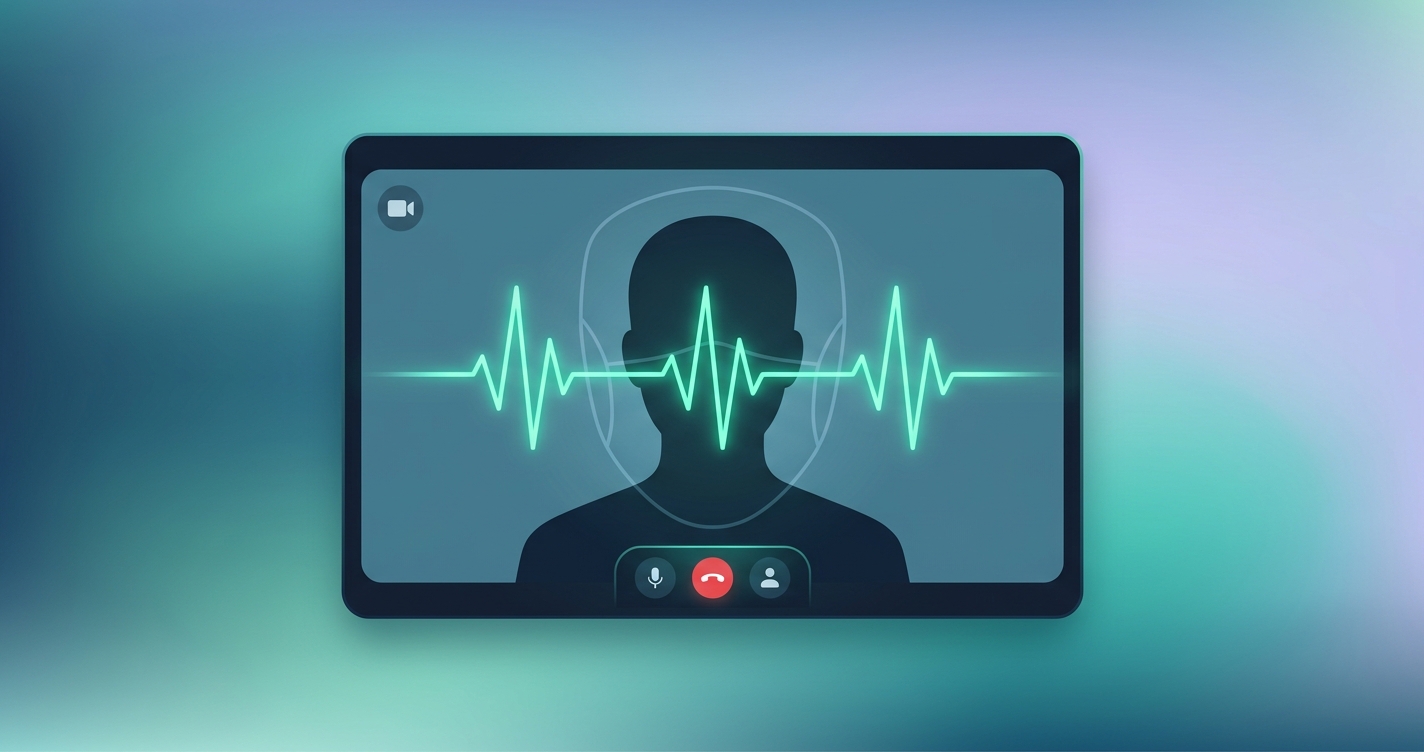
The question sounds simple until you try to answer it on a live chat window or a video support session: is the agent on the other end an actual person, a scripted bot, or a synthetic identity wearing a borrowed face? For consumers, human online support verification has quietly become one of the hardest problems in digital trust. The same tools that let a contact center scale support with AI assistants also let a fraudster impersonate one, and the visual and audio cues people once relied on (a slight pause, a natural laugh, a face that moves like a face) are exactly what generative models now reproduce on demand.
"Deepfake fraud attempts in contact centers surged by over 1,300% in 2024, and 1 in every 127 retail contact center calls was flagged as deepfake-related, with projections pointing toward 1 in every 56.", Pindrop 2025 Voice Intelligence and Security Report
That single shift reframes the whole conversation. The doubt a customer feels about whether a support agent is real is the consumer-facing symptom of a much larger structural failure in how interactions are authenticated. For identity verification vendors, banks, and fraud teams running support operations, the cost of getting this wrong is no longer reputational alone. It is measured in account takeovers, fraudulent refunds, and social engineering that walks straight past a human agent who cannot tell whether the "customer" they are helping is real either. The verification problem runs in both directions.
Why human online support verification broke
For most of the last decade, support authentication leaned on two crutches: knowledge-based questions and the assumption that a face or voice was inherently hard to fake. Both crutches have snapped. Knowledge-based answers leak in data breaches and sell cheaply. And synthetic media has erased the friction that used to make impersonation expensive.
The market context matters here. By 2025, industry estimates suggested as much as 95% of customer interactions would involve some form of AI, and roughly 65% of incoming support queries were being resolved without a human at all. That automation is legitimate and useful. The problem is that it normalizes a world where users can no longer assume the entity helping them is human, which is precisely the cover a fraudster needs. When everyone expects a possible bot, a convincing synthetic agent or a deepfaked caller attracts less suspicion, not more.
Human online support verification therefore has to answer two distinct questions at once:
- Is the support agent a real, authorized human being, and not an impersonator or unauthorized synthetic process?
- Is the customer the agent is helping a real, live human, and not a deepfake puppet or replayed recording?
The technologies that try to settle this fall into a few broad camps, and they are not equal in what they actually prove.
| Verification approach | What it checks | Defeated by | Best fit |
|---|---|---|---|
| Knowledge-based questions | Shared secrets and history | Data breaches, phishing, social engineering | Low-risk, legacy fallback |
| Voice biometrics | Vocal print match | Voice cloning, audio deepfakes | Phone channels with liveness add-on |
| Behavioral signals | Typing, mouse, timing patterns | Bots that mimic human cadence | Continuous background risk scoring |
| Document plus selfie match | Identity to ID photo | Injected images, face swaps | One-time onboarding |
| rPPG blood-flow liveness | Real pulse in live video | No genuine fix yet (needs a real circulatory signal) | Live video support and high-risk sessions |
The pattern in that table is the whole story. Every approach that relies on something a generative model can synthesize (a voice print, a face image, even a believable typing rhythm) inherits the weakness of the medium it trusts. The only category that asks for evidence a synthetic agent cannot produce is one that looks for a sign of being biologically alive.
The signal deepfakes cannot fake
This is where remote photoplethysmography, or rPPG, changes the math. rPPG reads the tiny periodic color changes in human skin caused by blood flowing through capillaries with each heartbeat. A standard camera captures it; no contact, no wearable, no extra hardware. A live human face carries this pulse signal. A deepfake-rendered face, a replayed video, a printed photo, or a 3D mask does not, because none of them have a circulatory system pushing blood under the skin in real time.
For human online support verification on video channels, that distinction is the use point. Instead of asking "does this face look real," which generative models keep winning, rPPG asks "does this face have a heartbeat consistent with a live person sitting in front of the camera right now." Synthetic media detection built on physiology sidesteps the arms race over visual realism entirely.
Industry applications for support and fraud teams
Call center and contact center fraud defense
Contact centers face fraud exposure that analysts have estimated in the tens of billions of dollars annually. When a support interaction moves to video (increasingly common for high-value account changes, wire approvals, and dispute resolution), a passive liveness check can run in the background while the agent talks to the customer. If the customer's face shows no genuine blood-flow signal, the session is flagged before any sensitive action is authorized. The agent does not have to play forensic analyst.
Identity verification vendors and KYC providers
For vendors selling verification as a service, the demand has shifted from one-time onboarding checks toward continuous assurance. Customers and regulators increasingly expect proof that the person in a live session is real, not just that an ID matched a selfie weeks earlier. Blood-flow liveness gives these vendors a defensible answer to the "is this a deepfake" question that document checks cannot provide on their own.
Bank and fintech support escalation
When a customer calls or video-chats to reset credentials or move money, that channel is the soft underbelly of remote banking. Fraud teams can route high-risk escalations through a video step where biometric liveness verification confirms a live human before the request proceeds. This protects the institution from impersonated customers and protects customers from agents who might themselves be impersonated in reverse social-engineering schemes.
Current research and evidence
The academic ground under rPPG has firmed considerably. Work published through IEEE in 2024 describes liveness detection methods using multi-task learning frameworks and multi-scale feature fusion networks specifically aimed at separating live faces from spoofs by their physiological signal. A 2024 review in the MDPI journal Electronics documents the maturing of rPPG for physiological sensing more broadly, including the deep-learning techniques that improve robustness across lighting conditions, head movement, and different skin tones, which were historically the technology's weak points.
The fraud data validates the urgency. Pindrop's 2025 report documented the 1,300% surge in contact center deepfake attempts and projected a further 162% rise. The FBI, as reported by Malwarebytes in 2025, tied nearly $900 million in American losses to AI-powered scams driven by voice cloning and deepfake technology. The gap between attacker capability and the defensive crutches still common in support operations is the core finding: impersonation has industrialized faster than verification.
The research consensus is not that any single method is a silver bullet. It is that anti-spoofing facial analysis grounded in a real biological signal raises the cost of attack in a way that signal-mimicking approaches cannot, because the attacker would need to generate genuine human physiology rather than a convincing picture of it.
The future of human online support verification
Three trajectories look likely. First, layering becomes standard. No serious fraud team will lean on a single check; expect blood-flow liveness, behavioral analytics, and channel risk scoring fused into one decision. Second, verification moves from a gate to a continuous property of the session, sampled throughout an interaction rather than once at the door. Third, transparency norms will tighten: as regulators push disclosure of AI agents, the contrast between a declared bot and a verified live human becomes a trust signal companies actively advertise.
The endpoint is a support experience where "is this a real person" stops being a guessing game. The proof is physiological, passive, and continuous, and it works the same way whether the question is about the agent or the customer.
Frequently asked questions
Can I personally tell if an online support agent is human in real time? Increasingly, no. Modern synthetic voices and faces reproduce the conversational and visual cues people used to rely on. Reliable human online support verification now depends on signals the user cannot perceive, such as the blood-flow pulse in a live video face, rather than on intuition.
How does rPPG prove a face is a live human and not a deepfake? rPPG detects the small, rhythmic color changes in skin caused by blood circulating with each heartbeat. A live person produces this signal naturally. Deepfakes, replayed videos, printed photos, and masks do not, because they lack a real circulatory system, which makes the pulse a strong liveness marker.
Does this require special hardware or a separate app for the customer? No. rPPG works with a standard camera feed, so it can run passively during a normal video support session without asking the customer to wear a device or download extra tooling. That keeps friction low while adding a hard-to-spoof verification layer.
Why do fraud teams care about verifying their own agents too? Social engineering runs both directions. A fraudster who impersonates a support agent can extract credentials and approvals from real customers. Verifying that an agent is an authorized live human closes a channel attackers actively exploit.
Circadify is building toward this exact problem: confirming a real, live human is present by reading genuine blood flow rather than trusting a face or a voice that generative models can now fake. If your support or fraud team needs to settle the "is this a real person, right now" question on live channels, explore an enterprise security demo to see how rPPG-based liveness fits into your verification stack.