
How Insurance Companies Use Liveness to Prevent Application Fraud
How insurance companies use liveness to prevent application fraud, from synthetic identity checks to deepfake-resistant onboarding in digital underwriting.
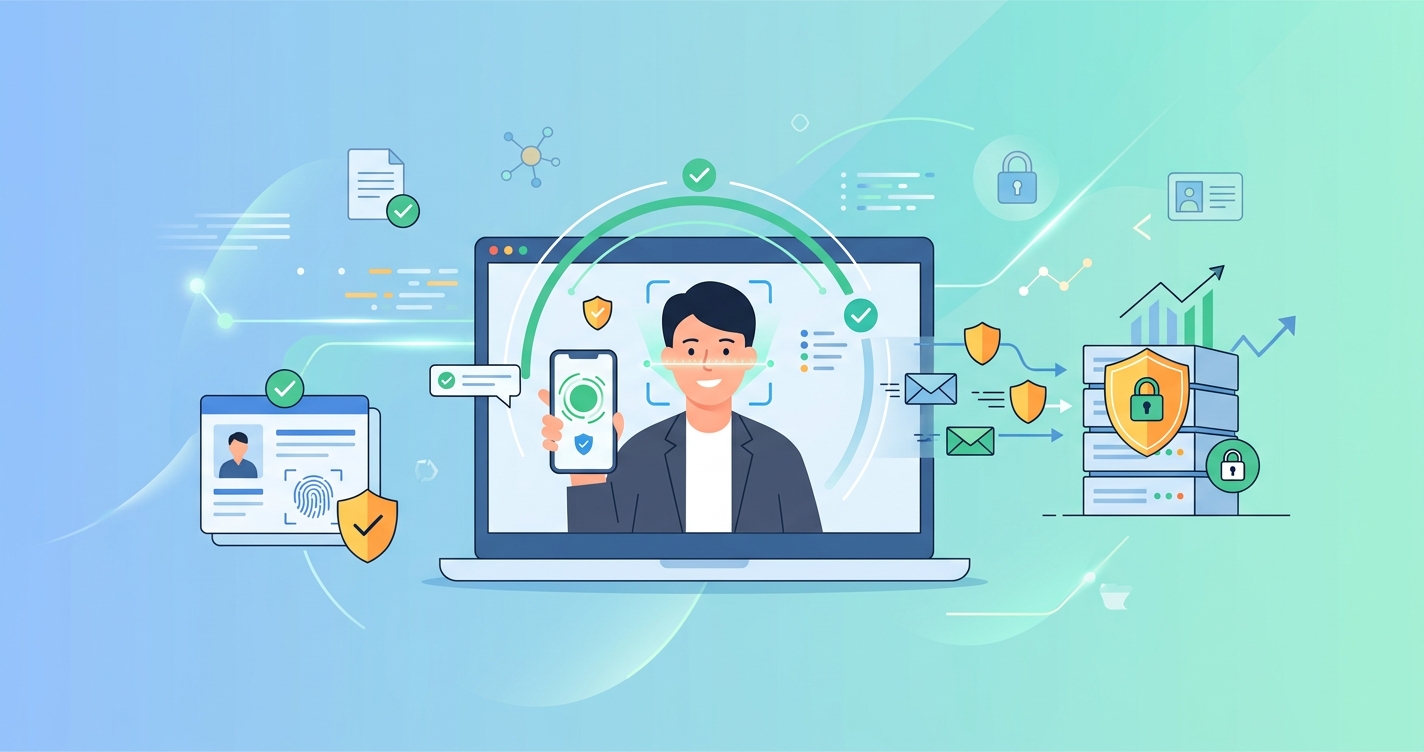
Insurance carriers have spent years tuning application fraud controls around document review, claims history, and data cross-checks. That stack still matters, but it is under strain. As digital underwriting moves more identity proofing and applicant intake online, insurers are now dealing with a different class of attack: synthetic identities, injected selfie videos, and deepfake-assisted impersonation. That is why insurance liveness prevent application fraud has become a serious underwriting topic rather than a niche biometric feature.
RGA’s 2024 U.S. life-insurance fraud survey estimated that synthetic identity fraud costs the industry about $30 billion annually, underscoring why digital applicant verification is moving higher on the underwriting agenda.
Why insurance liveness matters in application fraud prevention
In practical terms, liveness detection asks a simple question during digital onboarding: is the person on camera a real, physically present applicant, or a spoofed presentation? For insurers, that question matters at the start of the policy lifecycle. If a fraudulent applicant gets through identity proofing, every downstream control gets weaker.
Insurance application fraud usually shows up in a few forms:
- A real person applying under stolen identity data
- A synthetic identity stitched together from real and invented records
- A mule or stand-in completing video verification for someone else
- A replayed or AI-generated face stream used to pass selfie checks
- Coordinated fraud rings testing multiple carriers with slight identity changes
This is where liveness is useful. It gives underwriters and fraud teams another signal beyond “does the document look real?” and “does the face look similar?” A face match can still succeed against a manipulated onboarding session. A liveness layer tries to verify that the session itself came from a live person.
How insurers are deploying liveness inside digital underwriting
Most carriers are not building a separate fraud ceremony just for liveness. They are inserting it into steps that already exist:
- Selfie capture during identity proofing
- Video-assisted onboarding for higher-risk products
- Step-up verification for suspicious or high-premium applications
- Remote agent workflows where applicant identity must be reconfirmed
- Reverification when policy changes trigger a new fraud review
The operational appeal is obvious. Fraud teams want better detection without adding another long checklist for applicants. Signicat’s 2024 Battle to Onboard research found that onboarding friction still creates meaningful conversion drop-off. Passive liveness is attractive because it can run during the same capture flow already used for face matching.
Liveness methods insurers compare today
| Method | What it checks | Where it helps | Where it breaks down |
|---|---|---|---|
| Document verification | Whether an ID appears authentic | Basic onboarding hygiene | Cannot prove the presenter is the rightful applicant |
| Face match | Whether the selfie resembles the ID photo | Useful for identity proofing | A convincing impersonation can still pass |
| Active liveness | Blink, smile, or head-turn prompts | Stops some simple spoof attempts | Adds friction and can be mimicked by advanced attacks |
| Passive texture analysis | Visual artifacts in a face stream | Can catch some replay or render issues | Needs constant adaptation as generators improve |
| Physiological liveness analysis | Whether the video shows signs consistent with real blood flow and live capture | Stronger evidence of physical presence | Depends on signal quality, camera conditions, and implementation design |
That last category is where remote photoplethysmography, or rPPG, enters the discussion. rPPG extracts subtle color changes from facial video associated with blood volume changes over time. The foundational work by Gertjan de Haan and Vincent Jeanne (2013) on the CHROM method, and by Wenjin Wang, Sander Stuijk, and Gerard de Haan (2017) on the POS method, helped make robust camera-based pulse extraction much more practical under ordinary lighting and motion conditions.
Why rPPG gets attention in insurance liveness programs
Insurers do not care about rPPG as an academic curiosity. They care because it gives fraud teams a different evidence class.
Traditional selfie checks mostly evaluate appearance. Physiological liveness tries to evaluate whether the session behaves like live human tissue captured by a camera. That difference matters in an environment where deepfake tooling is getting easier to buy and easier to operate.
Researchers have been building this case for years:
- Verkruysse, Svaasand, and Nelson (2008) showed that ambient-light video from consumer cameras could recover pulse information from the face.
- de Haan and Jeanne (2013) introduced the CHROM approach for more robust remote pulse extraction under motion and illumination changes.
- Wang, den Brinker, Stuijk, and de Haan (2017) improved signal extraction further with the POS algorithm.
- A 2023 open-access deepfake study in Multimedia Tools and Applications reported that multi-region rPPG patterns remained useful for distinguishing manipulated face videos from authentic ones.
That does not mean insurers should treat any single liveness score as magic. It means the industry now has a credible technical path to test whether a remote applicant session looks physiologically plausible, not just visually convincing.
Industry applications in insurance fraud operations
New business underwriting
Application fraud hurts most when it enters the book at issuance. A synthetic or impersonated applicant can create losses before the carrier has enough behavioral history to spot anomalies. Liveness checks are therefore showing up closest to point-of-sale identity proofing, especially for direct-to-consumer and accelerated underwriting journeys.
Agent-assisted remote sales
When applications move through remote advisors, call centers, or hybrid digital flows, the carrier still needs confidence that the named applicant is the one completing the verification event. Liveness gives compliance and fraud teams a way to tighten identity assurance without forcing every case into manual review.
High-risk product segments
Some applications deserve a second look because of benefit size, premium financing, unusual payment setups, or mismatch signals across data vendors. In those cases, insurers can use step-up liveness checks as a selective control rather than a universal one.
Fraud-ring detection and triage
Liveness is most useful when it is combined with other signals:
- Device intelligence
- document-risk scoring
- velocity checks across applications
- network analysis on shared addresses, phones, or payment instruments
- manual review queues for borderline sessions
Fraud teams rarely win with one model alone. They win by stacking signals that are expensive for organized attackers to fake all at once.
Current research and evidence
The research base behind physiological liveness is stronger than many insurance executives assume.
A 2019 open-source review of remote heart-rate imaging in Behavior Research Methods concluded that facial rPPG can recover heart-rate information with consumer-level cameras under ambient light. That matters because carriers are not going to deploy specialty hardware for underwriting. They need methods that work with ordinary phones and webcams.
The academic literature has also become more specific on manipulated media. The 2023 paper “Local attention and long-distance interaction of rPPG for deepfake detection” argued that forged videos disrupt spatial and temporal pulse consistency across facial regions, and showed competitive results on FaceForensics++ and Celeb-DF benchmarks.
At the same time, the field has grown more realistic. Work discussed around FakeCatcher and later reviews has shown that deepfake detection is not as simple as saying “fake videos have no heartbeat.” Higher-quality manipulations may exhibit heartbeat-like artifacts. That is precisely why modern liveness systems look for consistency across regions, time windows, capture noise, and session integrity rather than relying on a single pulse reading.
Outside academia, insurance-specific fraud reporting is moving in the same direction. RGA’s 2024 fraud commentary on synthetic identities described AI as an accelerant for identity misuse, while Munich Re’s 2024 life-insurer survey reported applicant misrepresentation among the fraud categories trending upward for life carriers. Trade coverage in 2024 also highlighted a sharp increase in synthetic-voice and deepfake-linked insurance fraud attempts.
The future of insurance liveness
I think the next phase is less about “adding biometrics” and more about changing fraud economics. If carriers can require evidence of live presence during risky application moments, attackers lose some of the scale advantage they get from automated identity fabrication.
A few shifts are likely:
- Liveness scores will be fused with underwriting fraud models rather than treated as binary gates.
- Carriers will apply step-up checks selectively based on product risk and applicant anomaly signals.
- More insurers will want on-device or privacy-minimizing processing so raw video does not circulate unnecessarily.
- Fraud teams will test for injection attacks, not just photo or replay attacks, because attacker tooling keeps moving upstream into the camera pipeline.
That last point matters. The insurance industry is not fighting only fake documents anymore. It is fighting fake sessions.
Frequently Asked Questions
Why do insurers need liveness if they already use document verification?
Because document checks answer a different question. They help determine whether an ID appears valid. Liveness helps determine whether the person presenting that ID is physically present during the verification event.
Does liveness replace traditional underwriting fraud controls?
No. It works best as one layer inside a broader fraud stack that includes document review, data validation, consortium signals, device intelligence, and manual investigation.
Is passive liveness better than challenge-response checks for insurers?
Often, yes, if the goal is to reduce applicant friction. Passive methods fit more naturally into digital onboarding. But carriers still need to validate performance in their own flows, lighting conditions, and risk segments.
Can liveness stop every deepfake or impersonation attempt?
No control stops everything. The practical benefit is that liveness makes impersonation harder and more expensive, especially when it is combined with session-integrity checks and other fraud signals.
Insurance carriers are steadily moving toward identity controls that verify more than appearance. As application fraud shifts from forged paperwork to synthetic people and manipulated camera sessions, liveness becomes one of the few tools that can test whether a remote applicant is actually there. Circadify is building for that shift with physiological liveness approaches designed for modern fraud workflows. Explore Circadify’s fraud-detection work, or read more on how KYC providers add rPPG liveness to identity verification and why traditional deepfake detection fails.