
Is that really my daughter on the video call, or a deepfake?
A sudden video call from a family member in distress could be a deepfake scam. Learn how physiological signals like blood flow can be used to detect deepfake video calls.
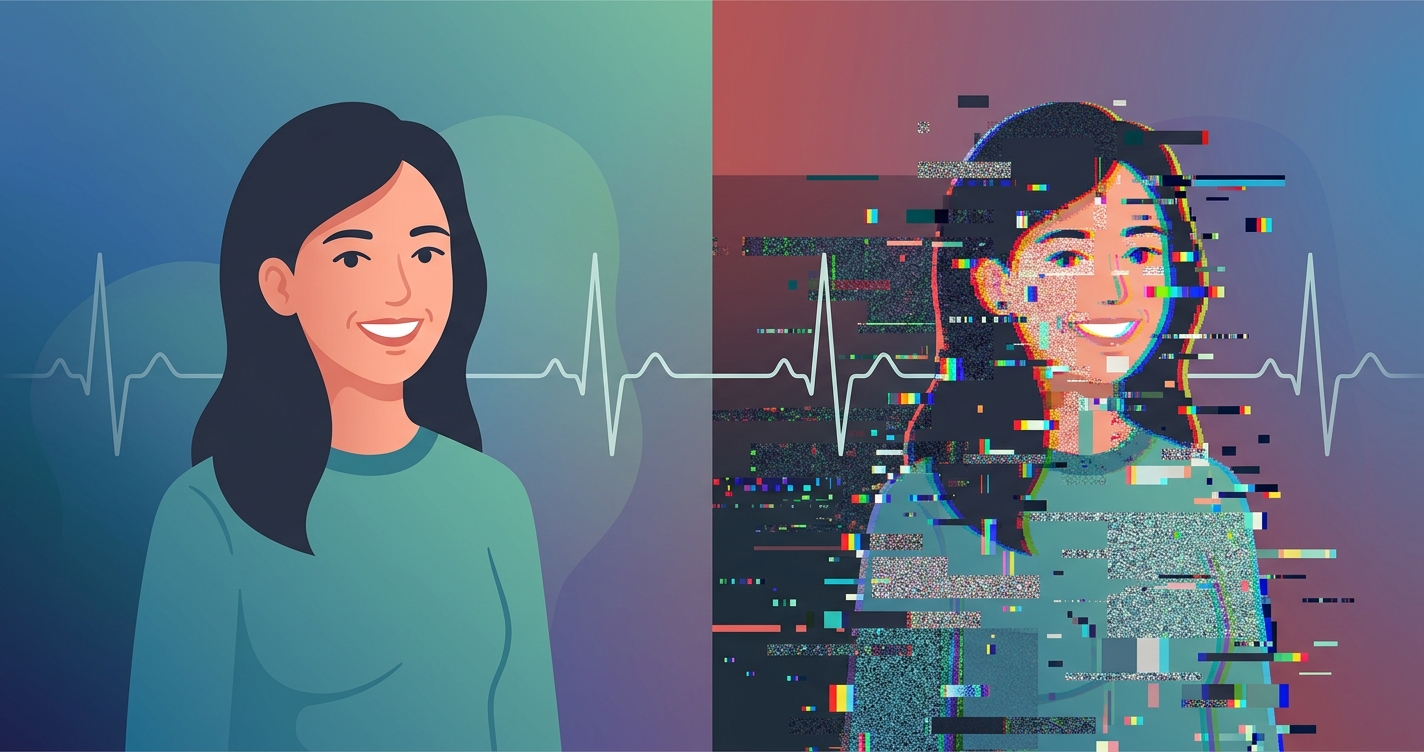
The video call rings, and it's your daughter's face on the screen. Her expression is one of panic. She says she's been in an accident, needs money for a hospital bill, and begs you to wire funds immediately. The situation feels urgent and real, but a flicker of doubt crosses your mind. The rise of sophisticated AI-powered scams has created a new, unsettling reality: the person on the other end of the line might not be your loved one at all. The core of this new security challenge is finding a way to reliably detect deepfake video call family emergencies. The answer lies not in analyzing pixels, but in verifying a fundamental sign of life that AI cannot replicate: the pulse of real blood flow under the skin.
"Imposter scams were the top fraud category reported by consumers in 2023, with reported losses reaching $2.7 billion. These scams include fraudsters pretending to be a friend or family member in distress."
- Federal Trade Commission, Consumer Sentinel Network Data Book (February 2024)
The analytical leap from pixels to physiology
For years, the primary method to detect deepfakes involved analyzing video for digital artifacts. Experts looked for unnatural blinking, strange lighting inconsistencies, or subtle digital "noise" left behind by the AI generation process. However, this approach is quickly becoming obsolete. Generative Adversarial Networks (GANs) and other AI models are now so advanced that they can produce high-resolution, real-time video streams that are visually indistinguishable from reality, even to a trained eye. The arms race has shifted. The most resilient way to detect a deepfake video call from family or anyone else is to look for signals that a synthetic creation cannot logically possess.
A living human being has a heartbeat. This physiological process pumps blood through the vascular system, causing microscopic changes in skin color as capillaries expand and contract. These changes, invisible to the naked eye, can be detected by analyzing the frames of a video stream using a technique called remote photoplethysmography (rPPG). A deepfake, no matter how visually convincing, is merely a digital puppet. It has no heart, no blood, and therefore, no pulse. By analyzing the video feed for the presence of this consistent, rhythmic, and biologically coherent signal, security systems can determine if the person on camera is a living, breathing human or a synthetic mask.
| Detection Method | How It Works | Strengths | Weaknesses |
|---|---|---|---|
| Visual Artifact Analysis | Scans video for tell-tale signs of AI generation like unnatural blinking, poor lip-sync, or rendering errors. | Simple to understand; effective against older or low-quality deepfakes. | Easily fooled by modern generative AI; artifacts are often removed by video compression. |
| Behavioral Analysis | Looks for unnatural facial expressions or movements that don't align with human norms. | Can sometimes flag a fake based on "uncanny valley" effects. | Highly subjective and unreliable; AI models are rapidly learning to mimic human behavior more accurately. |
| rPPG (Blood Flow) Analysis | Measures micro-color changes in the skin from video to detect the presence of a human pulse. | Based on an intrinsic, biological signal that is nearly impossible to fake in real-time. | Requires a clear, stable view of the person's face; dependent on video quality and lighting. |
Industry applications of physiological liveness
While the thought of a deepfake family scam is terrifying on a personal level, the underlying technology enabling it represents a critical threat to enterprises. The same tools used to impersonate a family member can be used to bypass identity checks for financial services, creating fraudulent accounts or authorizing illicit transactions.
Securing digital onboarding
For banks and fintech companies, video-based Know Your Customer (KYC) checks are a cornerstone of remote onboarding. A fraudster using a deepfake to impersonate a legitimate customer during a video interview could gain access to their accounts or open new lines of credit. Integrating rPPG-based liveness detection into the onboarding workflow ensures that a real person is present, not a digital injection attack.
Authenticating high-stakes transactions
Call centers that handle sensitive financial information or authorize transactions are another key target. A scammer could use a deepfake to impersonate a customer on a video support call to reset a password or transfer funds. Verifying liveness through physiological signals provides a layer of security beyond what knowledge-based questions can offer.
Preventing synthetic identity fraud
The most advanced fraud involves creating entirely new, synthetic identities. Deepfake technology allows fraudsters to give these synthetic identities a "face," making them appear more legitimate during video verification processes. By insisting on a "pulse of life," rPPG systems can reject these synthetic applicants at the source.
Current research and evidence
The field of rPPG for deepfake detection is advancing rapidly, driven by academic and commercial research.
- A 2023 study by researchers at the University of Amsterdam, "Applicability of rPPG-Based Deepfake Detection," explored using heart rate variability to differentiate real humans from fakes under various conditions.
- Work by Siwei Lyu and his team at the University at Buffalo has consistently highlighted the weaknesses of artifact-based detectors and pointed towards biometric signals as a more robust alternative. Their research demonstrates that while deepfakes can mimic appearance, they fail to replicate the complex and chaotic nature of human physiological signals.
- Commercial research is focused on making rPPG systems resilient to different lighting conditions, skin tones, and camera qualities, ensuring they work reliably in real-world applications. The consensus is clear: physiological data is the most reliable signal for detecting synthetic media.
The future of deepfake detection
The battle against deepfakes will be an ongoing technological arms race. As AI generators improve, so too must the detectors. The future of detection lies in a multi-layered approach, where rPPG is a critical component. Future systems will likely combine:
- Physiological analysis (rPPG): Verifying the subject is a living person.
- Behavioral biometrics: Analyzing unique patterns in how a person moves and speaks.
- Cryptographic verification: Using signed video feeds from trusted hardware.
For security providers, the goal is not to win the war in a single stroke, but to continually raise the cost and complexity for fraudsters, making attacks economically unviable. Physiological liveness detection is currently the most significant barrier that security teams can erect.
Frequently asked questions
Q: How can I tell if a video call is a deepfake? A: Look for inconsistencies in lighting and shadows, unnatural blinking patterns, and a flat vocal tone. However, the most reliable methods are technical. The best advice for a suspected family emergency scam is to hang up and call the person back on a known, trusted phone number.
Q: What is rPPG and how does it detect deepfakes? A: rPPG (remote photoplethysmography) is a technology that uses a standard video camera to detect the tiny color changes in human skin caused by blood flowing. Since these changes are tied to a real heartbeat, AI-generated deepfakes cannot reproduce them, making rPPG a powerful tool for confirming a person is real.
Q: Are deepfake scams involving family emergencies common? A: Yes. The FTC and other consumer protection agencies have issued multiple warnings about the rise of "grandparent scams" and other family emergency schemes that use AI voice cloning and deepfakes. These scams prey on emotion and urgency to trick people into sending money.
The technology to distinguish between a real human and a synthetic fake on a video call already exists. Circadify is at the forefront of deploying this technology to secure digital interactions, from consumer video calls to enterprise-grade identity verification. The same physiological detection that can protect families from fraud is what we use to help banks and financial institutions ensure that every user is exactly who they claim to be. Learn more about how we are solving these challenges at circadify.com/solutions/fraud-detection.