
Why do some apps ask me to blink or turn my head for verification?
Why an app asks to blink verification, the limits of active liveness, and how passive methods cut friction and stop deepfakes for KYC and fraud teams.
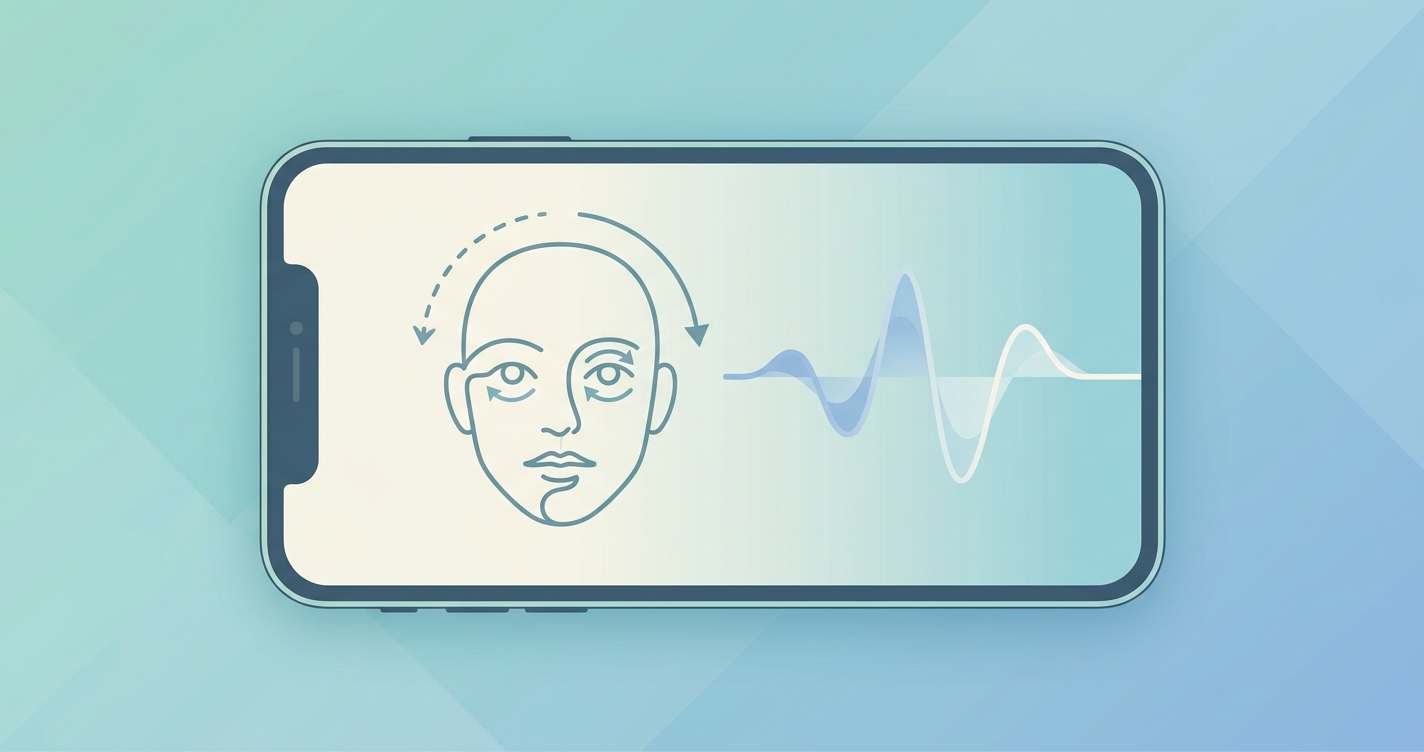
When an app asks to blink verification, smile on command, or slowly turn your head toward the camera, it is running a security check called active liveness detection. The goal is straightforward: prove that a real, living person is sitting in front of the lens, rather than a printed photo, a looping video, or a synthetic face. For the person holding the phone, the experience often feels clumsy. The instructions arrive at an awkward moment, the lighting is wrong, the timing is off, and a second or third attempt is needed before the system is satisfied. That friction is not an accident. It is the direct cost of asking a human to perform an action so a machine can watch how they respond, and it is the reason many identity verification vendors are now rethinking the approach.
"Switching from active to passive liveness detection increased customer application completion rates from 60% to over 95% in one onboarding case study, while the global liveness detection market is projected to grow from roughly $1.5 billion in 2024 to $6.2 billion by 2033.", synthesized from 2024 industry analyses including KYC-Chain and DataHorizzon Research
Why an app asks to blink verification, and what it actually tests
Active liveness is built on challenge and response. The system issues a randomized prompt and measures whether the face reacts the way a living person would. Common challenges include blinking on cue, turning the head left or right, smiling, nodding, or following a moving dot with the eyes. Because the prompt is unpredictable, the theory holds that a static attack such as a printed photo cannot satisfy it.
The weakness is that the test only measures behavior, not biology. It confirms that something on screen moved in the requested direction at the requested time. It does not confirm that the moving thing is a real human face attached to a circulatory system. As generative video tools have matured, this gap has become the central problem. A modern face-swap or animated avatar can blink, nod, and turn on command, because those are exactly the movements such models are trained to reproduce. When an app asks to blink verification from a fraudster running a real-time deepfake, the deepfake simply blinks back.
There is also a usability tax that fraud and product teams underestimate. Each added instruction is a moment where a legitimate user can stumble. Elderly applicants, people with motor or visual impairments, users in bright sunlight, and anyone in a hurry are all more likely to fail an active check and abandon the process entirely. In onboarding economics, every abandoned session is a lost customer who already wanted to sign up.
Active versus passive liveness at a glance
The industry generally splits liveness detection into two families. Active methods require the user to do something. Passive methods analyze the camera feed in the background without asking for any specific action. A subset of passive methods goes further and looks for physiological signals such as blood flow under the skin, an approach known as remote photoplethysmography, or rPPG.
| Dimension | Active liveness (blink, turn, smile) | Passive liveness (background analysis) | Passive rPPG (blood flow analysis) |
|---|---|---|---|
| User action required | Yes, multiple prompts | None | None |
| Typical capture time | 5 to 15 seconds | 1 to 3 seconds | 1 to 4 seconds |
| Friction and abandonment | High | Low | Low |
| Defends against printed photo | Strong | Strong | Strong |
| Defends against replay video | Moderate | Moderate | Strong |
| Defends against real-time deepfake | Weak | Variable | Strong by design |
| Signal measured | On-cue movement | Texture, depth, micro-motion | Pulse and blood flow under skin |
| Accessibility burden | Higher | Lower | Lower |
The pattern is clear. Active methods buy intuitive security at the price of friction, yet they struggle against exactly the threat that worries fraud teams most in 2025: animated synthetic faces that can follow instructions. Passive approaches remove the friction, and the physiological subset adds a defense that is genuinely hard to fake because it measures something a rendered image does not have.
Key trade-offs worth keeping in front of any vendor evaluation:
- Active prompts add seconds and cognitive load to every single legitimate session, not just the fraudulent ones.
- Challenge-response logic is publicly understood, which means attackers can script their deepfakes to satisfy the most common prompts.
- Passive analysis runs invisibly, so honest users never know a check happened, which raises completion rates.
- Physiological signals such as a measurable pulse are present in real skin and absent in screens, masks, and rendered video.
Industry applications
Banks and fintech onboarding
For remote account opening, abandonment is a board-level metric. Fraud teams want a hard stop against synthetic identities, while growth teams want the fewest possible steps between download and funded account. An app that asks to blink verification repeatedly during signup actively works against the growth side of that equation. Passive liveness, and especially blood-flow analysis, lets institutions keep the security bar high without forcing a performance from every new customer.
KYC and identity verification vendors
Vendors selling into regulated markets must demonstrate presentation attack detection under the ISO/IEC 30107-3 framework. Active challenge-response was an early answer to that requirement, but auditors and buyers increasingly ask a sharper question: how does the system handle injection of a real-time deepfake into the camera stream? Behavioral challenges alone do not answer it. Passive physiological detection gives vendors a differentiated story that holds up against the current generation of synthetic media.
Contact centers and high-value transactions
When a caller requests a wire transfer or a password reset, the verification moment has to be both fast and trustworthy. Asking a stressed customer to perform head turns mid-call degrades the experience. A background liveness check that confirms a living human is present, without interrupting the conversation, fits these moments far better.
Current research and evidence
Industry analysis through 2024 consistently links passive liveness to better conversion. One frequently cited onboarding case study reported completion rates rising from 60 percent under active checks to more than 95 percent after moving to passive detection, according to summaries from KYC-Chain. Market researchers at DataHorizzon Research size the broader liveness market at roughly $1.5 billion in 2024 with projected growth to $6.2 billion by 2033, growth driven specifically by demand for verification that is both secure and low-friction.
On the security side, vendors and standards bodies including iProov, FaceTec, and Onfido have documented how presentation attack detection is evaluated under ISO/IEC 30107-3, and how active challenge-response, while effective against static artifacts, was never designed for animated synthetic faces. Academic work indexed on ResearchGate, including studies using MediaPipe for blink and pose estimation, confirms that on-cue movements such as eye blinks and head poses can be modeled and reproduced, which is precisely why a movement-only test is a fragile foundation against deepfakes. The research consensus points toward layered detection, with physiological signals adding a dimension that behavioral tests cannot reach.
The future of liveness verification
The direction of travel is away from asking users to prove they are alive and toward systems that simply observe whether they are. As generative video keeps improving, any test based on copyable behavior will keep eroding. Blinks, smiles, and head turns are all learnable, and the tools to fake them are getting cheaper and faster. Detection that reads biology instead of behavior changes the contest, because a rendered face has no heartbeat to display and no blood moving beneath the surface.
Expect three shifts over the next few years. First, friction will be treated as a security liability in its own right, since every extra step trains users to click through warnings and gives attackers more known prompts to game. Second, regulators and auditors will press harder on injection and deepfake resilience rather than accepting movement-based proof. Third, physiological liveness will move from a premium add-on to a baseline expectation for high-risk flows. The awkward moment of being told to blink at your phone is likely to become a relic of an earlier era of identity verification.
Frequently asked questions
Why does an app ask me to blink or turn my head? It is running active liveness detection. The app issues a random instruction and checks whether your face responds correctly, which is meant to prove you are a live person rather than a photo or video. The catch is that it tests movement, not biology, so it can be fooled by animated synthetic faces that blink and turn on command.
Is blinking on command a secure way to verify identity? It defends well against simple attacks like printed photos, but it is weaker against modern real-time deepfakes that are specifically trained to reproduce blinks, nods, and head turns. That is why many vendors are layering in passive methods that measure physiological signals instead of relying on movement alone.
What is passive liveness detection? Passive liveness analyzes the camera feed in the background without asking you to perform any action. Advanced passive methods such as rPPG look for blood flow under the skin, a signal that a real face has and a screen or rendered video does not, which makes spoofing far harder.
Does removing the blink step make verification less safe? Not necessarily. Replacing a behavioral challenge with a physiological check can raise security while reducing friction, because it measures something attackers cannot easily fake and it does not interrupt the legitimate user.
Circadify is addressing this exact problem by reading real blood flow from a standard camera feed, detecting deepfakes and synthetic media without asking anyone to blink, turn, or perform on cue. Identity and fraud teams evaluating how to cut abandonment while hardening against synthetic attacks can explore the approach through an enterprise security demo.